

How to turn crawler logs and visibility measurements into a prioritized action list
Evidence in, ranked tasks out, and honest notes about what each fix cannot promise.

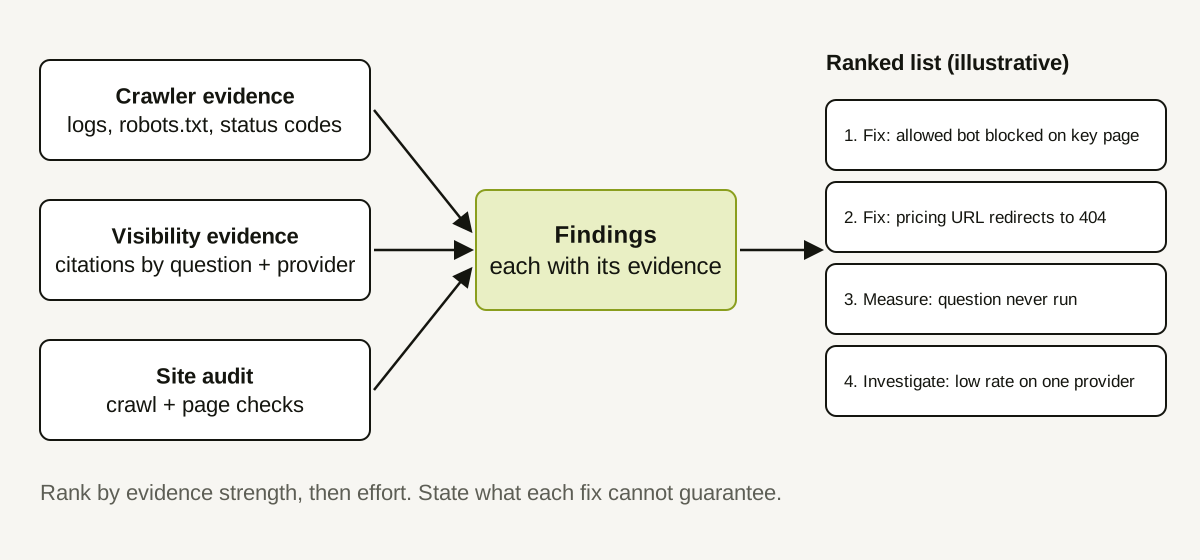
By the time you have crawler logs, a robots.txt review, and a few weeks of visibility measurements, you have a different problem: too many observations and no order. This article shows a method for turning raw evidence into a short, ranked action list, one a team can actually work through and that stays honest about uncertainty.
Two kinds of evidence
Crawler evidence describes what automated visitors requested from your site: which user-agents (as claimed), which URLs, which status codes, and what your robots.txt allows. It tells you about access.
Visibility evidence describes what assistants said when asked your tracked questions: which domains they cited, for which questions, from which providers. It tells you about outcomes.
Neither explains the other by itself. A crawler can fetch a page that is never cited, and a page can be cited without any visit you can see. Linking them is a hypothesis you test, not a fact you read off a chart.
Step 1: Write findings, not tasks
A finding is one observation with its evidence. Write each one in the form:
Observation (what you saw) · Evidence (where to verify it) · Scope (which pages, questions, providers).
Examples:
- "robots.txt Disallow rule matches
/pricingfor the wildcard group. Evidence: robots.txt lines 4–5. Scope: 1 page." - "Three internal links point to
/compare/acme, which returns 404. Evidence: link list with source pages. Scope: 3 pages." - "Your domain is not cited on any of the five comparison questions, but a tracked competitor is cited on four. Evidence: question-by-provider table. Scope: 5 questions, 2 providers."
- "Provider B returned errors for half the questions this week. Evidence: run log. Scope: 12 questions."
Notice that none of these says why. Cause comes later, and only when evidence supports it.
Step 2: Classify each finding
Give every finding two labels:
- Type
- Fix: a defect you can correct (a broken link, a blocking rule).
- Investigate: something that may or may not be a problem (a crawler rarely visits a page).
- Measure: a gap in data (a question never run).
- Provide information: a fact the team must supply (a pricing detail that conflicts across pages).
- Evidence strength
- Verified: you can reproduce it right now (a 404).
- Supported: the data points to it, but alternatives exist.
- Hypothesis: a plausible explanation that needs testing.
Step 3: Rank
Sort by this order, using each as a tie-breaker for the one above:
- Measurement gaps that invalidate other findings. If a provider failed, fix coverage before trusting its numbers.
- Verified defects on important pages.
- Evidence strength. Verified before supported before hypothesis.
- Page importance. Pricing and product pages ahead of old blog posts.
- Effort. Small fixes first among equals.
This is a sorting rule, not a prediction. A higher rank does not mean a higher chance of getting cited; it means "most certain and most useful to do first."
Step 4: Attach a verification step to every action
An action without a way to check it is a wish. For each one, write:
- The change: what exactly will be different.
- The check: how you will confirm it, such as a re-fetch showing a 200 or a robots.txt test passing.
- The follow-up measurement: what you will look at later, and when.
- What it cannot promise: for example, "Fixing the block does not guarantee any crawler will visit or cite the page."
A worked example (illustrative)
A team compiles this table after a month of data:
| # | Finding | Type | Strength | Page importance |
|---|---|---|---|---|
| 1 | Provider B failed on 12 of 24 questions | Measure | Verified | n/a |
| 2 | Disallow: /pricing applies to search crawlers | Fix | Verified | High |
| 3 | /compare/acme returns 404, linked from the footer | Fix | Verified | Medium |
| 4 | Brand not cited on 5 comparison questions | Investigate | Supported | High |
| 5 | Pricing facts differ between two pages | Provide information | Verified | High |
The ranked list:
- Resolve the provider B failure (otherwise findings 4 may be a measurement artifact).
- Remove or justify the robots rule on pricing.
- Fix or remove the footer link.
- Decide which pricing facts are correct and update both pages.
- Re-check the comparison questions after fixes 1–4.
Item 4, the visibility finding, sits last because it depends on the earlier fixes. The team records: "No claim that fixes 2–4 will change citations. Re-measure in four weeks."
Pitfalls
- Ranking by drama. The most surprising chart is not necessarily the most useful action.
- Treating hypotheses as facts. Label them.
- Bundling. One finding, one action, one check. Bundles hide what worked.
- Silent closure. An action is not done until its verification step has been run.
- Forgetting what was ruled out. Keep a "checked, no issue" list. It prevents repeat work.
How Doclight helps
Doclight builds recommended actions from a versioned rule catalog. Technical findings come from the latest website crawl (broken links, sitemap errors, unexpected noindex or canonical tags, robots.txt rules that block documented answer-surface crawlers, invalid structured data), content findings come from per-question assessments whose quotes and page references are validated, and visibility findings are calculated from your measurements (competitor gaps by question and provider, unmeasured questions, provider failures). Each action carries its evidence, a category and type (fix, investigate, measure, provide information), a next step, verification instructions, and a status you can set.
Ordering is deterministic: priority group, then evidence strength, page importance, affected pages, effort, and freshness. Doclight states that this ordering is not a probability of success. Content findings are always labelled as hypotheses.
It does not use your server logs unless you send bot-visit events through its API, and it cannot guarantee that completing an action will lead to a citation.
Checklist
- Each finding has observation, evidence, and scope
- Type and evidence strength assigned
- Measurement gaps ranked first
- Verification step written for every action
- "Cannot promise" noted
- Re-measure date scheduled
Sources and verification
Product behavior (rule categories, action types, ordering, and statuses) was checked against Doclight's metric definitions and rule catalog on 2026-10-12. The table and the list are illustrative.
Related: how to separate incomplete measurement from low visibility.