

How to investigate the questions where competitors appear and your brand does not
A seven-step review that turns a competitor-only citation into a testable hypothesis.

You run your tracked questions and find a pattern: for "best tool for onboarding new customers," a competitor is cited and you are not. It is tempting to open the page editor immediately. Don't. A competitor-only citation is a symptom with many possible causes, and a rewrite aimed at the wrong one costs time and teaches you nothing. This article walks through a review that ends in a hypothesis you can test.
It builds on comparing visibility with competitors, which covers the fixed scope you need before any of this makes sense.
Step 1: Find the exact cells
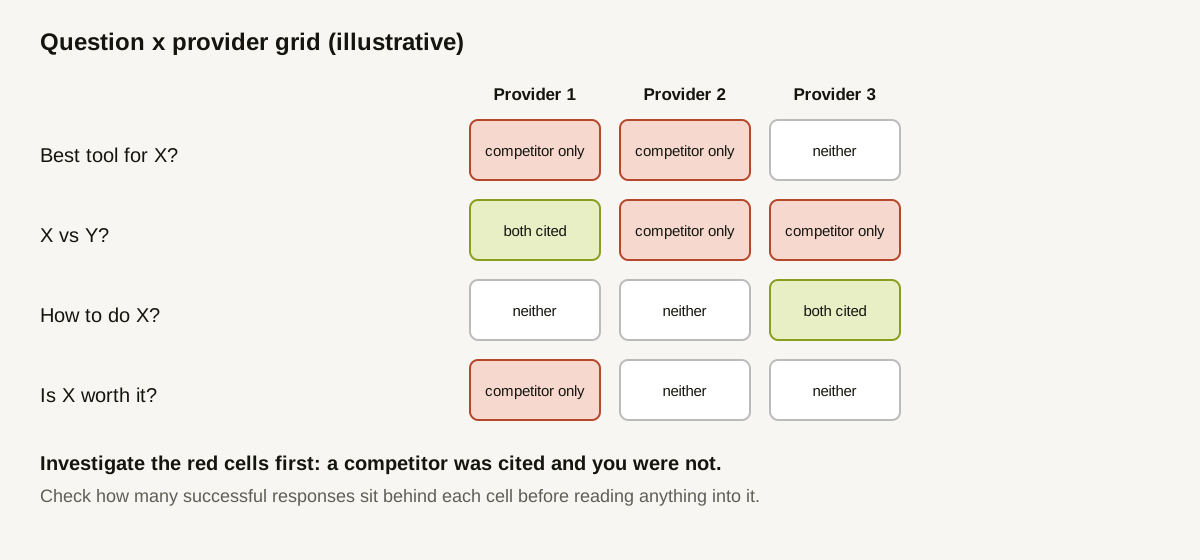
A "cell" is one question on one provider. Instead of "we lose to Competitor A," list the specific cells where, across successful responses, the competitor was cited and your brand was not. Keep the count of successful responses next to each cell. One response is an anecdote; several repeats are a pattern.
Step 2: Confirm it repeats
Providers do not answer identically every time. Before investigating a cell, check whether the pattern shows up across more than one run. If it appeared once and never again, record it and move on. If it repeats, it earns a closer look.
Step 3: Rule out measurement problems
Before blaming your content, make sure the cell is not a measurement artifact:
- Did every run for that provider succeed, or did some fail or stay pending?
- Was the question edited during the window, so older and newer responses are not comparable?
- Is the question's language and market setting what you intended?
- Is the competitor you see actually the one you track, rather than a similarly named domain?
A failed measurement is a gap in coverage. It is not a competitor win, and it is not a problem with your website.
Step 4: Classify the question
Questions behave differently by type:
- Branded questions name you. Missing here is serious, and usually a retrieval or identity issue.
- Unbranded comparison ("X vs Y," "best tool for Z") reward pages that compare fairly and third-party lists.
- How-to questions reward pages that answer the exact task.
- Definitions often cite reference and documentation pages.
The type tells you which kind of page you would need, and whether a page of that type is something you could honestly publish.
Step 5: Read what was cited
Open the pages cited alongside the competitor and read them as a buyer would. Note the page type (their own docs, a comparison, a review, a news article), what sub-question it answers directly, and whether it states something specific, such as a number, a limitation, or a step list. The next article covers evaluating those source pages in more depth.
Then open your closest matching page. Does it exist? Is it reachable and readable by a crawler? Does it answer the same sub-question in plain language? Check access first, since a page that cannot be fetched cannot be cited; robots.txt and status codes are the usual suspects.
Step 6: Write the hypothesis
State a hypothesis you could be wrong about:
On "best tool for onboarding new customers," Competitor A is cited by two providers across four of five responses and we are not. Their cited page is a comparison guide with a feature table; we have no comparison page. Hypothesis: a fair comparison page covering the same sub-questions would make us eligible for citation. Test: publish it, re-measure the same cells.
Note the careful verbs: "eligible," "re-measure." You cannot promise a citation.
A worked example (illustrative)
Suppose a team's grid shows four competitor-only cells out of twelve. They investigate each:
| Cell | Repeats? | Measurement clean? | Finding | Action |
|---|---|---|---|---|
| Best tool for X, Provider 1 | Yes (3 of 4) | Yes | Competitor's cited page is a comparison; we have none | Draft a fair comparison page |
| X vs Y, Provider 2 | Yes (2 of 3) | Yes | Cited page is a third-party review of both | Check our listing on that site; no page change |
| Is X worth it, Provider 1 | No (1 of 5) | Yes | One-off | Record, re-check next week |
| How to do X, Provider 3 | Yes | No, two runs failed | Coverage problem | Re-run before concluding |
Out of four cells, one calls for new content, one for outreach to a third party, one for waiting, and one for fixing measurement. A team that rewrote pages for all four would have been wrong about three. All figures here are invented for illustration.
Step 7: Change one thing, then re-measure
Pick the single change your hypothesis supports. Log it with its date and URL, keep the question set unchanged, and re-measure the same cells after enough time and runs have passed. Report the result as an observation, and say what else changed in the window. Documenting changes for a before-and-after comparison is the topic of a later article.
What not to conclude
- That the competitor's page is "better." It is cited, which is not the same as better.
- That copying its structure will earn a citation. Assistants do not publish their selection rules.
- That the gap exists in consumer chat apps. API measurements and chat interfaces can differ.
How Doclight helps
Doclight's report includes a missed-questions view: a question is listed only when, in the window, a tracked competitor was cited in a successful response and your brand never was, with the count of successful responses for that question and how often each competitor appeared. The competitor deep dive adds the question-by-provider gaps and the pages the competitor was cited for. A "competitor gap" recommended action carries that evidence and states that the cause is not established, asking you to compare questions and pages before changing anything. After a change, a re-check can compare measurements taken before and after, flagged as not proving cause.
Doclight cannot say why a competitor is cited, and it will not prescribe a content change without question-and-page evidence.
Checklist
- List competitor-only cells with their response counts.
- Confirm repeats across runs.
- Rule out failed runs, edited questions and market mismatches.
- Classify the question type.
- Read the cited pages and your closest page.
- Write one falsifiable hypothesis.
- Change one thing, log it, re-measure.
Sources and verification
Checked on 2026-10-12 against this repository's METRIC_DEFINITIONS.md (missed questions, recommendation re-checks) and the competitor deep-dive and visibility rule code under backend/app/analytics and backend/app/actions. No external research is cited. The grid and table are illustrative.
For a broader checklist of causes, see why your company might not show up in ChatGPT recommendations.