

Incomplete measurement or genuinely low visibility? How to tell the difference
A zero can mean 'not cited' or 'not measured.' Report which one it is before anyone reacts.

A report shows your brand cited in 4% of responses. The first reaction is alarm. The better first reaction is a question: 4% of what? If the number came from a handful of responses, from one provider that mostly failed, or from questions that were never run, the low figure may describe the measurement rather than your visibility.
This article gives you a short decision flow for separating coverage (how much you measured) from visibility (what the measurement found), and the language to report each honestly.
Two different questions
- Coverage: Did we actually measure what we think we measured? Which questions, which providers, how many successful responses, over which period?
- Visibility: Given what we measured, how often and where did assistants cite us?
You can only answer the second after you have answered the first. A visibility number computed from thin coverage is not a low number; it is an unreliable one.
Six ways coverage falls short
- Questions not run. A new question was added but the scan has not happened yet, or a question was paused.
- Provider failures. One provider returned errors for part or all of the period. Failed responses are not "not cited."
- Pending responses. Runs that never finished.
- Too few responses. With only a handful of successful responses, one different answer swings the percentage.
- A narrow market. You measured one language or country, but your buyers use another.
- Short window. One week is not a trend. Answers vary between runs.
Each of these produces low or noisy numbers without saying anything about how assistants treat you.
A decision flow
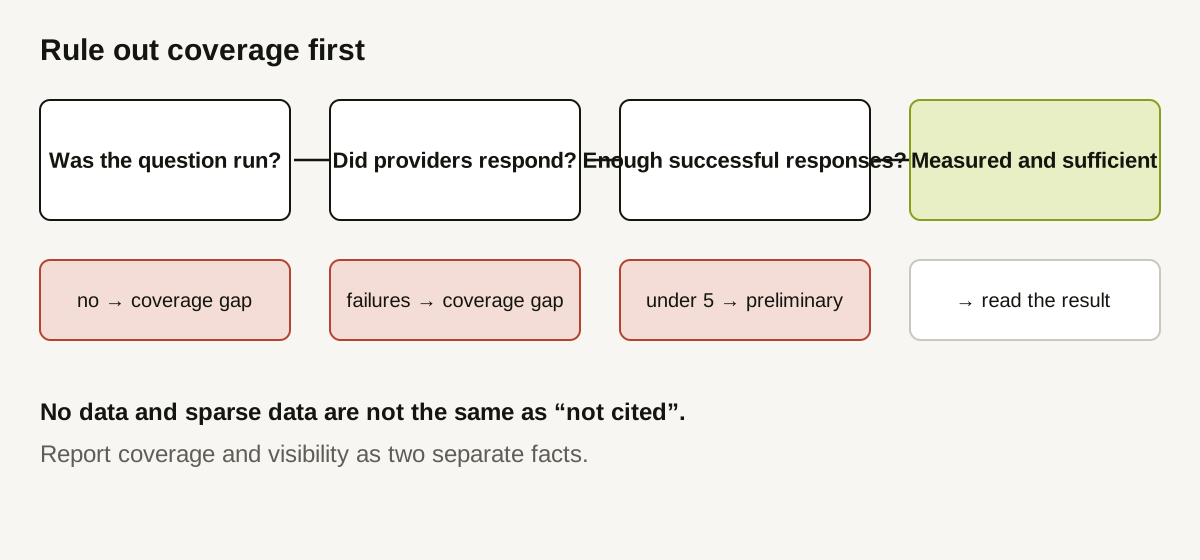
Work through these in order and stop at the first "no."
- Was the question run in this period? If not, the finding is coverage gap: unmeasured.
- Did each provider return successful responses for it? If not, coverage gap: provider failure.
- Are there enough successful responses to read? Many teams treat fewer than about five as preliminary. If so, sparse data.
- Is the market scope right? If you tracked the wrong language or country, you measured a different audience.
- Is the window long enough to compare? If not, label any change as provisional.
- Only now: read the visibility result and, if it is low, investigate causes.
A worked example (illustrative)
A team tracks 20 questions on two providers. The weekly report says the brand domain was cited in 1 of 14 successful responses (7%).
Walking the flow:
- Run? 20 questions were scheduled, but 8 were added this week and have not run yet. Only 12 questions have data.
- Providers? Provider A returned responses for all 12. Provider B failed on 10 of its 12, so its 2 successes are all that count.
- Enough? 14 successful responses sounds acceptable, but 12 come from provider A and only 2 from provider B. Provider B's reading rests on two answers.
- Market? All questions are in English for one country; the team's main customers are elsewhere. Note it.
- Window? One week.
The honest report is not "visibility is 7%." It is: "In week 1, 12 of 20 planned questions ran. Provider B failed on 10 of 12. Of 14 successful responses, our domain was cited in 1. Provider A: 1 of 12. Provider B: 0 of 2 (too few to read). Coverage is incomplete; do not interpret this as a trend."
Two weeks later, all 20 questions have run and provider B has recovered. The same brand is cited in 5 of 38 successful responses (13%). The earlier number was a coverage artifact: the brand was not twice as visible, the measurement was just more complete.
When visibility really is low
Once coverage is complete, a low result still deserves care:
- Check distribution. Is it low everywhere, or zero on certain question types (such as comparison questions) and fine on others?
- Check providers separately. Behavior differs between assistants.
- Read raw responses. What do they cite instead? Is your content absent from the results or just outranked?
- Check access. Are key pages reachable and allowed? See how HTTP errors affect access and what robots.txt tells you.
- Check content fit. Does a page of yours answer the question in plain text near the top?
Even then, avoid claiming a cause. Low citation tells you where to look, not what is wrong.
Wording that keeps you honest
| Instead of | Say |
|---|---|
| "We have 7% visibility." | "7% of successful responses (1 of 14) cited our domain; coverage was incomplete." |
| "Provider B never cites us." | "Provider B returned 2 successful responses; neither cited us. Too few to read." |
| "Visibility fell this week." | "Citations fell, but 8 new questions had not yet run and provider B failed on most questions." |
| "No data means no citations." | "No data means not measured." |
How Doclight helps
Doclight reports data sufficiency separately from results. For each period it states the number of distinct questions evaluated, attempted, successful, failed, and pending responses, which providers were actually measured, and which only failed. It labels the period as no data (nothing attempted), sparse (fewer than five successful responses), or sufficient, with a plain-language explanation and no numeric "confidence score." Citation rate excludes failed and pending responses and shows its denominator. Visibility findings flag unmeasured questions and providers whose responses all failed as measurement gaps, and provider comparisons only use questions measured in both windows.
One honest limit: the platform shows which providers are integrated separately from which produced data, and an integrated provider can still have no measured responses in a period. Also, the minimum of five successful responses is a rule of thumb for flagging preliminary periods, not a statistical guarantee.
Checklist
- Planned versus run questions compared
- Provider failures counted separately
- Successful responses per provider stated
- Market and window noted
- Visibility reported with its denominator
- "Not measured" never written as "not cited"
Sources and verification
Data-sufficiency behavior was checked against Doclight's analytics code and metric definitions on 2026-10-12. The example is illustrative; no customer data is used.
Related: a weekly monitoring routine and reading citation rate and share.
Once you know the data is complete, why your company might not show up in ChatGPT recommendations lists the causes worth checking next.