

What AI visibility actually measures: mentions, citations, and attribution
Three words get used as if they meant the same thing. They are three different levels of evidence.

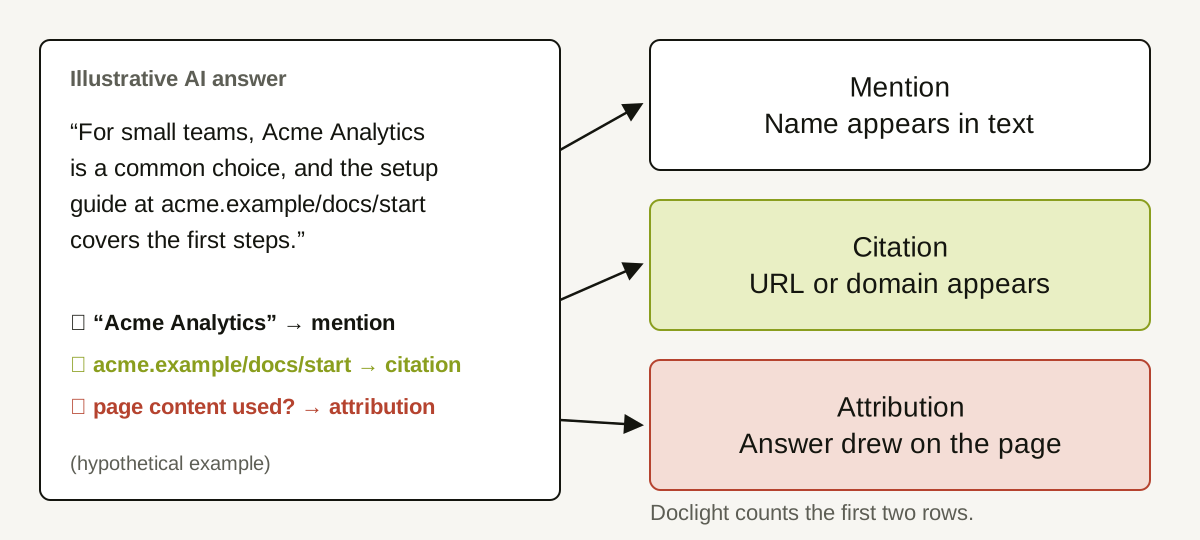
AI visibility measures three things about your brand in AI answers: whether ChatGPT, Claude, Perplexity or Gemini names it (a mention), whether the answer links to your site or names it as a source (a citation), and whether the answer was built from your page (attribution). Mentions and citations can be read directly from an answer; attribution can only be supported with evidence, not proven by a link.
"AI visibility" is a phrase that sounds precise and is not. Ask five marketers what it measures and you will get five answers: how often an assistant says our name, how often it links to us, how often we show up first, how often it "knows" us. Before you track anything, decide which of those you mean, because they are different measurements with different evidence behind them.
This article separates three terms (mention, citation, and attribution), shows what each one can and cannot prove, and ends with a short method for deciding what to measure first.
Mention: your name appears in the answer
A mention is the weakest and most common signal. The assistant writes your brand or product name somewhere in its answer. There may be no link, no source, and no indication of where the name came from. It may come from the model's training data, from a search result, or from a list the model reproduced from memory.
Mentions matter because buyers read the text. If a prospect asks for tools in your category and your name is in the list, that is exposure. But a mention alone tells you very little about why it happened, and it is hard to measure reliably, because names are ambiguous. A product called "Notion" or "Linear" collides with ordinary words, and a misspelling or a nickname will slip past a simple text match.
Citation: a URL or domain appears
A citation is a concrete, checkable artifact: the answer includes a link, or a domain-shaped string such as example.com/docs/start. You can verify it by looking at the response. You can count it. You can compare it week to week.
Two details are worth knowing:
- A citation can be a full link or a bare domain written in the text. Those are different forms of the same signal.
- A citation to a page does not tell you what the assistant did with the page. It shows that the domain was surfaced to the reader, not that the sentence next to it was derived from that page.
Citations are the most measurable layer, which is why most tracking tools are built around them. Doclight records citations and, separately, exact name mentions.
Attribution: the answer drew on your page
Attribution is the claim that the content of the answer came from your page. This is what most people secretly want to know: did my article shape what the model said?
It is also the hardest to establish from the outside. A link next to a sentence suggests a relationship, but the system's internal use of sources is not visible to you. An answer can use a page without linking to it, and it can link to a page it barely used. Treat attribution as a hypothesis you can support with evidence (for example, an answer that quotes a distinctive phrase that only exists on your page), never as something a link count proves.
Why the distinction changes your decisions
Suppose a weekly check shows your brand name in 12 of 20 answers but your domain in only 3. Those are different problems:
- Name without a link suggests the assistant knows you but is not pointing readers to you. You may want to check whether the pages that answer the question are crawlable and clearly written.
- A link without the name suggests your content is being used as a reference for answers that recommend someone else, or answer neutrally.
- Neither suggests a measurement question first (did the check run?) and a content question second.
If you only ever track "visibility" as a single number, those three situations look identical.
A worked example (illustrative numbers)
The numbers below are invented to show the method, not results from a real brand.
A small SaaS company tracks 10 buyer questions across two assistants, one run each, for 20 responses in total. Reading every response by hand, the team records:
| Observation | Count |
|---|---|
| Brand name appears in the text | 9 |
| Brand domain appears as a link or bare domain | 4 |
| Both | 3 |
| Answer quotes a phrase unique to the brand's page | 1 |
Reading it back: the name shows up in 9 of 20 responses (45%), the domain in 4 of 20 (20%), and only one response gives real evidence of drawing on the page. The honest summary is "we are known, we are sometimes linked, and we have one example of apparent use," not "we have 45% visibility."
How to choose what to measure
- Write down the decision the number will inform. If you are deciding whether to improve your docs, citations are the most useful signal. If you are deciding on brand messaging, mentions matter more.
- Pick one primary metric and name it precisely. "Share of responses that link to our domain" is a metric. "AI visibility" is a category.
- Record the denominator. Responses, questions, and providers are different denominators. Say which one you used.
- Keep a list of questions and re-run the same ones. A changing question set makes every comparison unreliable.
- Read a sample by hand. Automated parsing is a convenience. Spot-check at least a handful of responses each cycle so you know what the numbers hide.
What Doclight measures, and what it does not
Doclight runs the questions you define against the AI assistants it integrates with (ChatGPT, Claude, Perplexity and Gemini) and records two things from each response. Citations: full links and bare domains in the answer. Mentions: your brand name or domain appearing in the answer, matched exactly on word boundaries, plus your position when the answer is a numbered list. It tracks both over time, compares you against competitor domains you choose to track, and reports mention rate, citation rate and citation share with their denominators stated.
Name matching is exact, so misspellings, nicknames and names other than the ones you registered are not counted. Doclight does not turn the order of names in prose into a rank, and it cannot tell you whether a page was actually used to write a sentence. A domain showing up next to your brand is also not evidence that the other domain knows about you.
A short checklist before you start
- I know whether I care about names, links, or evidence of use.
- My primary metric has a precise name and a stated denominator.
- My question list is fixed and saved.
- I know which assistants and countries or languages I am measuring.
- I have a plan to read a sample of raw responses.
Sources and verification
Product behavior described here was checked against the Doclight codebase and its metric definitions on 2026-10-12. The numbers in the worked example are illustrative. This article makes no claim about how any assistant chooses its sources; it only describes what can be observed in a response.
Next in this series: how to establish an AI visibility baseline for a SaaS brand and how to read citation rate and citation share. To start tracking by hand, see how to track whether ChatGPT mentions your brand; if you are not showing up at all, work through why your company might not show up in ChatGPT recommendations.